
A fighting chance
A life shaped by woods and fields

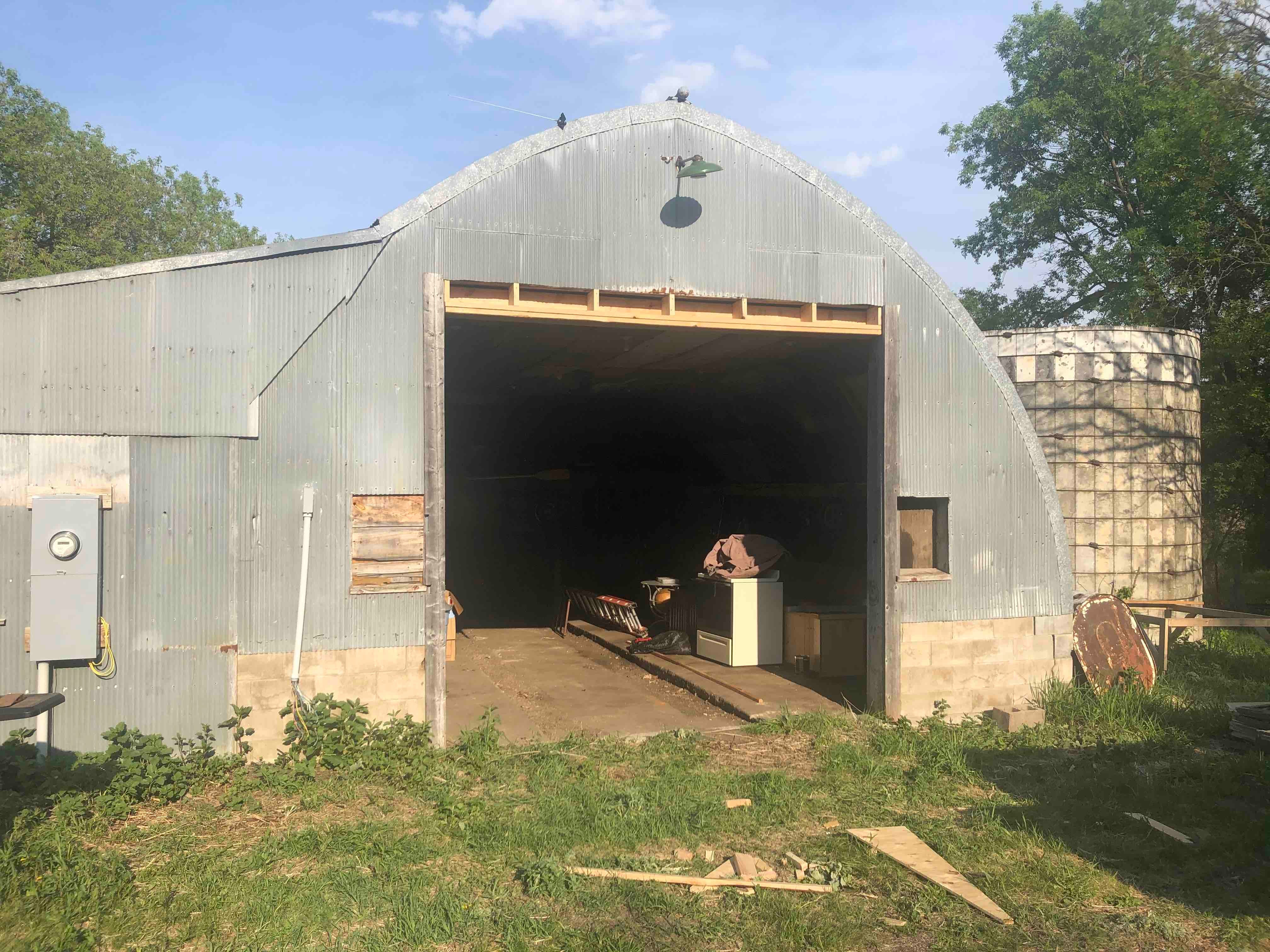
You can see the silo peeking out from behind the barn.
There’s an old silo on my farm, down the slope next to the barn. Like most silos these days it’s empty, and its top stands open to the sky. Generations of silage decaying have created rich soil in its base, and some safety conscious soul blocked up the access hatch with a wire hog panel. Likely that’s because the inside is now full of broken glass, old tires, rusty tin cans, and empty antifreeze jugs.
The silo is about fifteen feet across and about the same high, made of cement blocks stacked on end. Metal hoops keep the cement blocks in place. I mostly ignore the silo. Lisa and I have had lots of conversations about what we could do with it: a recording studio, a greenhouse, build a room on top for a writing studio. A planetarium. We laugh, and go back to ignoring it.
Inside that cylinder, a few hardy plants have taken root. This spring I looked inside and on the far side, peeking over the dogwoods, a poplar tree rattled its pale leaves at me.
I love poplar trees. Last year I transplanted half a dozen of them into a shelterbelt west of our house. I watered and watched all summer, excited to see them taking root and doing well.
Then one night in September, a little whitetail buck rubbed his antlers around on all six of them, stripping their bark. Their tops are dead this spring. But they’re sprouting from the bases, so that’s promising. That darn buck didn’t kill the roots, thank goodness.
I looked at this particular poplar in the silo, thinking about the future. His trunk sprouted up through a tire. Not promising. He reached high for the sunlight, probably eight feet.
That’s big to transplant.
And he was already leafed out. It was late in the spring for transplanting a tree.
But if I left him there in the silo, what would happen? He’d be hidden at best, and probably wouldn’t survive very long.
Could I transplant him into my shelterbelt?
One night I dug a hole west of the house, north of my damaged poplars with the leaves growing out by the base of their trunks. I dug deeper and wider than I thought I’d need to, and added a good measure of topsoil to enhance the sand that I had dug out. Then I ran a hose to the silo and sprayed gallons of water around the base of the poplar tree. Let them soak overnight.
The next night there was rain in the forecast. Storm clouds building in the west, I wedged myself through the access hatch (climbing up over the hog panel six feet up to get in), threw the shovel and a sawzall ahead of me, and climbed down among the tin cans and broken glass.
My first plan was to use the sawzall to cut the tire off the little tree’s trunk. But it was a steel belted radial in remarkably good shape, and didn’t want to be cut.
Plan B. I cut down with my spade in a wide circle around the outside of the tire, feeling for the main tap root that most poplars have.
I noticed that something along the way had damaged the trunk of this little tree, probably when it was very small. Maybe a raccoon clambered over it exploring the garbage heap, or maybe someone (maybe even me) carelessly threw something aside, not thinking about the damage it could cause. The tree had recovered, and there’s a little jag in the trunk now.
My goal was to keep as many roots intact as possible. Once my spade had completed the circle, and I tossed garbage across to rest next to the dogwood, I lifted the poplar gently. The roots came free, reluctantly, from the damp soil.
Eight feet of trunk and wobbly branches shook over my head as I drew the main root out through the tire. I suppose because of the lack of wind in the silo, and the rich soil, the roots were not very robust.
Good news, they pulled out through the tire easily. Bad news, this tree was going to be stressed once it was transplanted.
I eased the roots out through the access hatch, letting the crown of the tree follow. A couple branches broke off in this birthing process. I climbed up a step on the hog panel, and reached as far as I could to set the tree down outside the silo. Dark blue clouds cast an eerie light over the evening. The storm was building in the west, winds swirling fitful outside the silo.
I managed to extricate myself, the spade, and the sawzall from the concrete prison. Without wasting any time I grabbed the tree and the spade and headed for the hole I’d dug the night before.
Growing up in that sheltered place, this little tree was weak and wobbly. I got the roots buried, carefully packing layers of dirt around them. The trunk still wasn’t likely to stand in a stiff breeze.
I buried a couple steel posts and ran straps loosely around the trunk. I didn’t want to imprison this little tree, I wanted to set it free. The loose straps would hopefully keep it from blowing over, but allow the trunk and the roots to build strength by enduring the wind.
A five gallon bucket of water, drizzled over the disturbed earth, completed the transfer, moistening all that soil and hopefully enticing the root hairs (what remained of them) to stretch into the soil and grab hold.
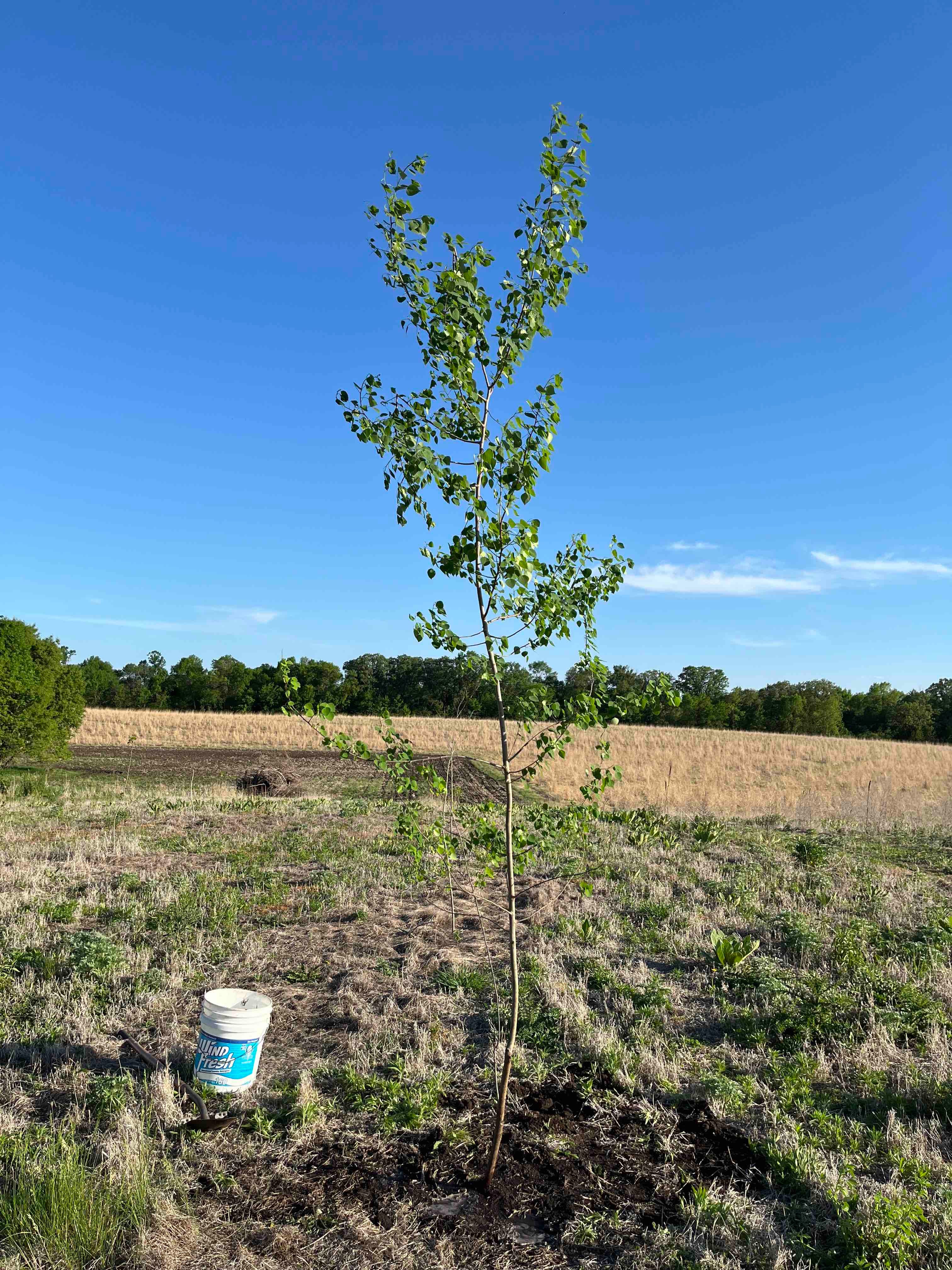
The poplar in his new location.
I watched, doubtful. I’ve transplanted a lot of trees in my lifetime, and I know what happens. You damage the roots severely in digging it up.
For the first couple days, the leaves looked fine. Then they started wilting.
I expected this.
A couple branches had been damaged in the passage from concrete to the outside world. They went brown first.
The rest of the tree looked thirsty, in spite of the moist soil around the roots. Leaves went soft and stopped doing that cool poplar thing they do in the breeze.
After three days, you could see that the little tree was doing a sort of self-selection. There wasn’t enough root structure to support every leaf that had come outdoors. About half the leaves wilted, then went brown. The rest greened up again.
I started to feel a sense of hope the morning I could see those remaining leaves dancing in the air currents.
I stood looking at that tree: brown, desiccated leaves, green vibrant ones. I thought about the journey it had suffered, out of the concrete walls that bound it. I thought about the damaged roots striving to grow back into the soil. I looked at the straps providing support.
I felt a deep kinship with this little poplar. I have been uprooted a few times myself.
It’s not that God sets out to damage us. But in order to set us free, he has to release us from those things that imprison us. Sometimes even the walls that shelter us become a prison.
I don’t know yet what will happen with this little poplar. There are no guarantees for trees, or for people. He’s got a fighting chance, though, and is showing signs of life.
I have high hopes that someday my grandkids will use that crook in his trunk as a foothold when they climb too high in this poplar to terrorize their parents.
What a precious story! There really are a lot of similarities between different forms of life -- sometimes a shot of "fertilizer" (love/TLC) is all it takes for survival. Looking forward to hearing what you and Lisa decide to do with that silo!